


Most people associate a PoSH Awareness Programme with legal compliance. They expect to learn about policies, procedures, and the provisions of the Prevention of Sexual Harassment (PoSH) Act.
While these are important, they are only the starting point.
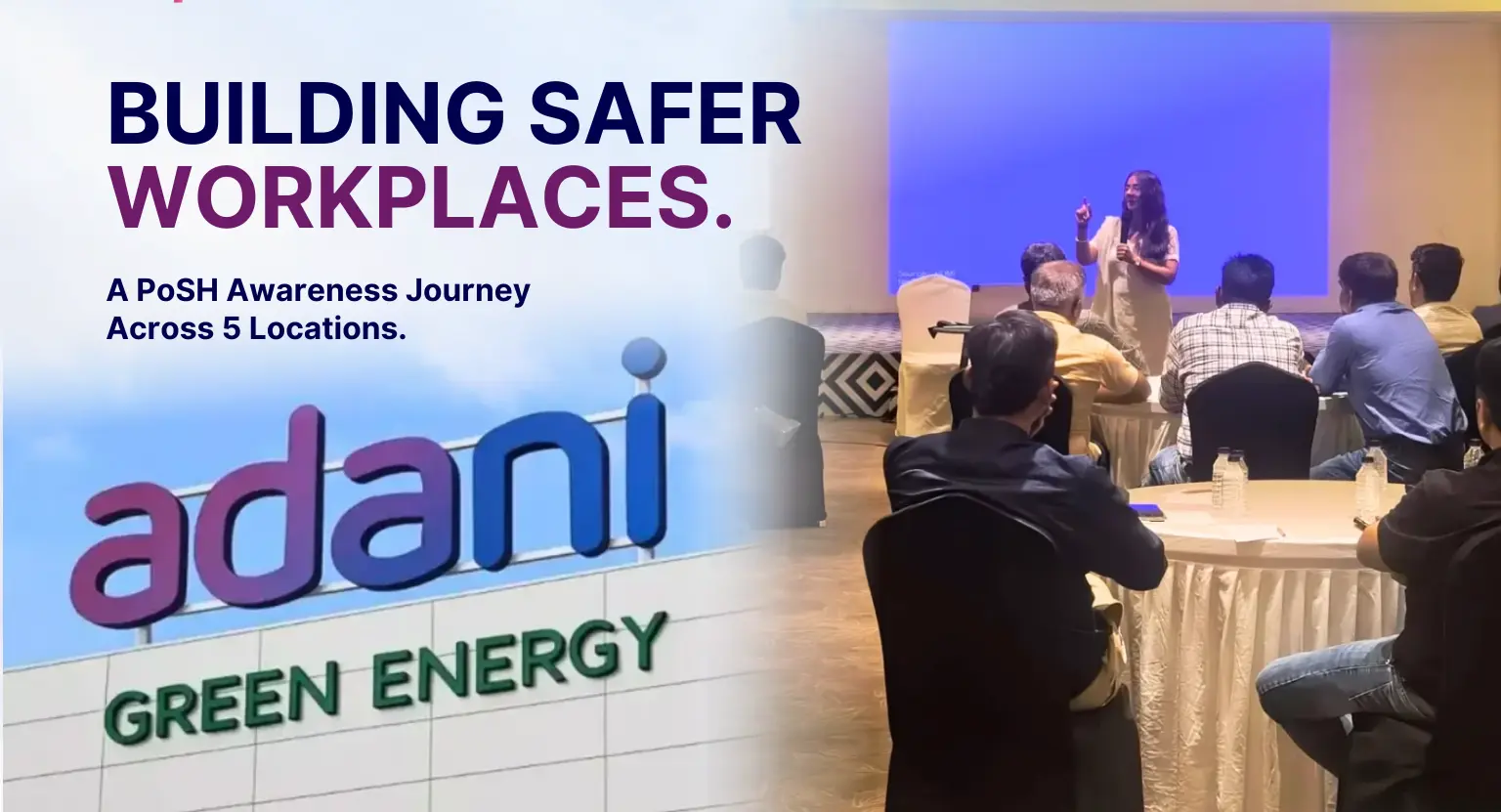
Our recent PoSH Awareness Programme conducted for Adani Green Energy reinforced something we have observed over the years. The most meaningful outcomes of these sessions don’t come from explaining the law. They come from honest conversations that encourage employees to reflect on their everyday behaviour, question long-held assumptions, and understand that workplace respect is everyone’s responsibility.
Every organization has its own culture. Every workforce brings unique experiences. Yet one message remained consistent throughout these discussions:
A safe workplace is not created by policies alone. It is created by people who choose to respect every single day.
Why Awareness Matters Beyond Compliance
The PoSH Act provides organizations with a legal framework to prevent and address sexual harassment at the workplace. However, compliance alone cannot create a respectful work environment.
Policies become meaningful only when employees understand how they apply to everyday situations.
A well-designed awareness programme helps employees:
- Understand what respectful workplace behaviour looks like.
- Recognize conduct that may be inappropriate, even when it is unintentional.
- Learn how and when concerns can be reported.
- Understand the role of the Internal Committee.
- Discuss real workplace situations instead of only legal definitions.
- Realize that creating a safe workplace is a shared responsibility, not just an HR function.
The objective is not simply to explain the law. It is to help employees make better decisions in everyday workplace interactions.
Every Conversation Was Different
One of the biggest learnings from this programme was that every audience brings a different perspective.
Some participants preferred listening quietly before asking questions.
Others became highly engaged the moment practical workplace scenarios were introduced.
Managers viewed discussions through the lens of leadership and accountability. Employees were more interested in understanding situations they may encounter during their day-to-day work.
Despite these differences, one thing remained common.
People connected far more with real-life conversations than with legal terminology.
When participants discussed situations they had seen, experienced, or wondered about, the sessions became more meaningful and memorable.
People rarely remember sections of an Act. They remember conversations that change the way they think.
When the Conversation Shifted Beyond the Law
One discussion stood out because it reflected a reality many professionals silently experience.
A participant raised a concern about workplace gossip and how professional success is sometimes overshadowed by assumptions about personal relationships.
The question wasn’t about filing a complaint.
It wasn’t about legal procedure.
It was about dignity.
The discussion reminded everyone in the room that respect is not limited to avoiding inappropriate comments. It also means recognising colleagues for their work, avoiding unnecessary assumptions, and creating an environment where people can contribute confidently without fear of judgement.
Comments that may appear casual or harmless can slowly affect an individual’s confidence, reputation, and sense of belonging.
These are exactly the kinds of conversations that help organizations move beyond compliance and towards a healthier workplace culture.
Challenging Common Misconceptions
Every PoSH awareness programme brings certain misconceptions to the surface.
One of the most common is the belief that false complaints are widespread.
Open discussions helped participants understand that while false complaints can occur, they are far less common than public perception often suggests.
At the same time, participants also discussed the importance of fairness throughout the inquiry process.
A credible PoSH mechanism ensures:
- Every complaint is heard with sensitivity.
- Every respondent receives a fair opportunity to present their perspective.
- The Internal Committee remains neutral and unbiased.
- Decisions are based on evidence and legal principles rather than assumptions.
Understanding this balance helps employees develop confidence in the process instead of fear around it.
Another important discussion focused on the role of men in creating respectful workplaces.
PoSH is sometimes misunderstood as legislation that concerns only women.
In reality, workplace culture improves only when everyone participates.
Men have an important role in:
- Challenging stereotypes.
- Discouraging disrespectful conversations.
- Supporting professional equality.
- Contributing to a culture built on dignity and mutual respect.
Creating a safe workplace is not the responsibility of one gender or one department. It belongs to everyone.
Respect Is Built Through Everyday Behaviour
One insight continued to emerge throughout the programme.
Respect cannot begin and end inside meeting rooms.
It is reflected in the language people use, the assumptions they make, and the way they speak about colleagues when those colleagues are not present.
This becomes even more important in project environments where women may represent a smaller part of the workforce.
Professional capability should never be overshadowed by stereotypes, gossip, or personal assumptions.
Organizations create truly inclusive workplaces when employees learn to appreciate people for their contribution rather than allowing biases to influence workplace interactions.
Respect is not simply the absence of inappropriate behaviour.
It is the presence of empathy, professionalism, fairness, and accountability.
Why Continuous Awareness Matters
Many organizations conduct PoSH training once a year because compliance requires it.
Workplace culture, however, is built through continuous reinforcement.
Teams evolve.
Work environments change.
Technology has transformed the way people communicate, making professional boundaries more complex than ever before.
Regular awareness sessions give employees an opportunity to:
- Revisit important workplace behaviours.
- Clarify doubts.
- Discuss emerging situations.
- Challenge outdated beliefs.
- Strengthen a culture of mutual respect.
Leadership plays a critical role in this journey.
Employees often observe what leaders do more closely than what policies say.
When leaders consistently demonstrate respectful behaviour, encourage open dialogue, and address concerns fairly, those values naturally become part of the organization’s culture.
What These Conversations Taught Us
Every awareness programme leaves us with valuable learning.
Some discussions reinforce existing understanding.
Others introduce entirely new perspectives.
This programme reminded us that employees are looking for more than legal awareness.
They want practical guidance.
They want clarity.
They want the confidence to respond appropriately when faced with difficult workplace situations.
Most importantly, they want to work in environments where respect is demonstrated through everyday actions rather than written only in policy documents.
That is why meaningful awareness programmes focus not only on compliance but also on behaviour, communication, and culture.
The One Message Every Workplace Should Remember
If there is one message we hope every participant carries back after attending a PoSH awareness session, it is this:
Respect is not a compliance requirement. It is a workplace value.
Creating safer workplaces is not achieved through one policy, one training session, or one annual compliance activity.
It happens through consistent conversations, thoughtful leadership, fair processes, and everyday choices made by every individual in the organization.
When employees feel respected, they contribute with greater confidence.
When leaders model respectful behaviour, teams follow.
And when organizations continue investing in awareness, they create workplaces where every employee feels valued, heard, and safe.
That is the purpose behind every PoSH Awareness Programme we conduct, and it continues to guide every conversation we have.
About the Programme
We recently conducted a series of PoSH awareness programs for Adani Green Energy.
The sessions were designed to go beyond legal compliance by encouraging meaningful discussions around workplace behavior, respect, accountability, and inclusion. Through practical examples and open conversations, participants explored not only the provisions of the PoSH Act but also the everyday actions that contribute to building safer and more respectful workplaces.
Because lasting workplace culture is shaped through continuous dialogue, we remain committed to helping organizations create environments where respect is not just a policy, but a shared value practiced by everyone.