


PoSH Non- Compliance in 2026: Fines , License Cancellation, and 5 Real Consequences for Indian Companies
If your organization employs ten or more people and does not have a functional Internal Committee(IC) you are not in a gray area but in a violation. As of 2026, it is much simpler for regulators, investors, and the general public to identify your breach of Section 26 of the PoSH Act, 2013.
Here’s what happens when a business doesn’t comply, and why it’s worse than ever to learn the hard way in 2026.
What is the Penalty for Non- Compliance with the PoSH Act?
The PoSH Act’s Section 26 establishes the standard penalty structure.
A fine of up to Rs. 50,000 for the first offence
If an offense is committed again, the penalty is doubled, and the authority may suggest that the business license or registration needed to operate to revoked, withdrawn, or not renewed.
That’s the statutory floor. See the 2026 Escalation box below for a complete view.
5 Consequences of PoSH Non- Compliance
1. Section 26 Direct Monetary Fines
Failing to constitute an IC, failing to act on an IC’s recommendations, or failing to file the mandatory annual report to the District Officer are each treated as independent statutory violations. Each can draw a fine of up to Rs. 50,000 on a first offence. Some states have gone further — Tamil Nadu, for instance, has issued directives allowing fines up to Rs.1 lakh for failing to constitute an IC.
2. Cancellation of a license or registration
The majority of businesses undervalue this outcome. In addition to imposing a punishment, Section 26 expressly gives the government or local authority the authority to revoke, withdraw , or decline to renew the license or registration required for a business to operate. This is not speculative; it is explicitly stated in the statute as an escalation option beyond the monetary punishment and usually occurs after persistent or unresolved offenses.
3. No IC Means No Legal Shield — and Compounding Liability
You face more than simply the Section 26 penalties if your business has no IC at all. Every complaint that comes in has nowhere to go, which leads to a build-up of delays, improper treatment, and procedural errors, each of which is a distinct, punishable infraction. In situations when complainants were pushed into civil or labour court litigation due to the lack of a functional grievance procedure, courts have also directly granted compensation to them. No IC lowers your risk; instead, it increases it.
4. Personal Liability for Officers — Not Just the Company
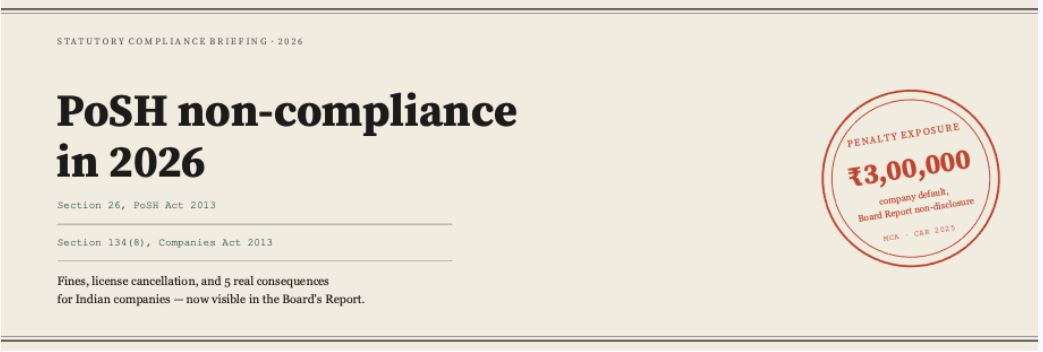
These days, non-compliance is more than just a business issue. Failure to comply with Board Report disclosure requirements related to PoSH data may result in penalties for the company and its relevant officers under section 134(8) of the Companies Act, 2013. The company may be fined up to Rs. 3,00,000 while individual executives may be fined up to Rs. 50,000. The accountability of “the employer” which in many systems refers to whoever is in charge of compliance rather than an abstract corporate body, is also considered in Section 26.
5. It’s Now in the Board’s Report — Visible to Regulators, Investors, and the Public
This is the consequence that changed everything in 2025–2026.
2026 Escalation: The Board Report Disclosure Penalty
The Ministry of Corporate Affairs’ Companies (Accounts) Second Amendment Rules, 2025 (notified 30 May 2025, effective 14 July 2025) rewired how POSH compliance gets disclosed. Previously, a company could include one vague line in its Board’s Report confirming an IC existed. That’s no longer enough.
Companies must now disclose, every year, in the Board’s Report filed under Section 134 of the Companies Act:
- The total number of sexual harassment complaints received during the financial year
- The number resolved
- The number pending for more than 90 days (the statutory inquiry deadline)
- A workforce gender breakdown (female, male, transgender employees)
- A formal statement affirming compliance with the Maternity Benefit Act, 1961
This data gets filed electronically via Form AOC-4 and is now part of the public corporate record — visible to shareholders, auditors, regulators, and anyone who pulls the filing. A company that quietly ignored its IC obligations for years can no longer hide that in a one-line disclaimer.
And the penalty for getting this disclosure wrong stacks on top of the original Section 26 fine:
| VIOLATION | PENALTY |
| SECTION 26 — NO IC / NON-COMPLIANCE / FAILURE TO FILE ANNUAL REPORT | Up to ₹50,000 (first offence), doubled on repeat, license cancellation possible |
| SECTION 134(8), COMPANIES ACT — FALSE OR MISSING BOARD REPORT DISCLOSURE | Up to ₹3,00,000 for the company, up to ₹50,000 for the officer in default |
This dual-enforcement structure is deliberate. It connects POSH compliance directly to corporate financial reporting law, meaning a labour-law gap can now trigger a corporate-law penalty too. Regulators don’t need a complaint to catch you — an inconsistency in your own annual filing can do it.
Are Certain States or Smaller Cities Exempt from PoSH Non- Compliance?
No. Regardless of company’s location or industry, the Board’s Report disclosure mandate is applicable to all establishments in India with ten or more employees. There is a persistent notion that PoSH enforcement is primarily a big-city, big-company issue, particularly among smaller manufacturing and trading companies outside of the major metropolises.
Imagine a scenario that is becoming more and more likely under the current regulations: a mid-sized Surat textile trading company that is completely compliant with GST and labour returns receives a notice regarding it PoSH filings – not due to a harassment complaint, but rather because its Board Report disclosure did not meet the requirements of the new regulations or because it lacked a functional IC despite having more than ten employees year prior. That situation has nothing to do with location. It has to do with the fact that most businesses have only been monitoring one of the two checklists – routine financial-return compliance and PoSH compliance.
Under PoSH, Can an Employer Be held Personally Liable?
Yes, in two different ways:
1. According to Section 26, the employer is liable for the IC & reporting errors. This can really refer to the person in charge of compliance rather than just the business as an abstraction.
2. In addition to the company’s payment, the “officer in default” for Board Report disclosure violations is subject to personal penalties under Section 134(8) of the Companies Act.
Compliance can no longer be treated as something that happens to “the company” in the abstract. It is attached to specific people.
The Conclusion
The actual risk was never the Section 26 fine. The true risk in 2026 is that PoSH compliance has subtly evolved into a financial reporting need with its own set of penalties, built on top of the initial labour law requirement. This requirement is now visible to regulators, investors, and journalists in a public filing.
CTA:
Not sure if your organization is fully PoSH compliant? Even one missing compliance requirement can expose your organization to legal, financial and reputational risks.
Book a free PoSH Audit Call with Shivani today and assess your compliance readiness.
Call/WhatsApp: 7874462266/9227075527
Email: info@proudhr.com